Soldiers in Afghanistan Focused on Allen's 2012 Objectives By Donna Miles American Forces Press Service KABUL, Afghanistan, Dec. 23, 2011 - As the top U.S. commander in Afghanistan looks to 2012 as a time to build on gains made and extend the security zone east of Kabul, the soldiers of Regional Command East know they have a vital role to play in making that possible.
And as "significant counterinsurgency operations" continue in the east, Allen said his goal is to push the security zone east of Kabul. In addition, he cited an evolution toward an advisory mission in Afghanistan to enhance capability within the Afghan security forces as the United States looks toward scaling back its combat mission there. Army Col. Edward T. Bohnemann, commander of the 172nd Infantry Brigade, recognizes the emphasis that puts on his soldiers in remote but strategically important Paktika province. Bohnemann's brigade is deployed from Grafenwoehr, Germany, with its headquarters just 30 miles from the Pakistan border at Forward Operating Base Sharana. Among his combat outposts sprinkled through the province, some are directly west of the border. Paktika province is home to historic transitory routes between the two countries. It's also an infiltration point for fighters, munitions and weapons filtering into Afghanistan bound for Kabul, Kandahar and the northern regions. Bohnemann noted the challenge of stretching his soldiers and their Afghan counterparts to cover such a vast region. "There are too many small goat trails [and] small dirt roads to say I am going to have a hard stop at the border," he said. "It's too big of a border." Some of the border areas are so remote that when an incident occurs, "trying to get there rapidly becomes problematic," he said. So Bohnemann and his soldiers concentrate on improving the trends and making the most effective use of the capabilities they have. "I focus my soldiers on, how do we interdict, neutralize, slow the flow so that other places can build capacity [and] build on the security gains they have seen throughout the areas of Afghanistan," he said. Choking that flow, he recognizes, will be critical to Allen's goal of expanding the security zone around Kabul. "My piece of that is ... to stem the flow of weapons [and] fighters to the security zone," he said. Exacerbating the challenge, he acknowledged, is Pakistan's decision to scale back cross-border coordination following the Nov. 24 border incident that killed 24 Pakistani soldiers. "There is not a whole lot of cross-border coordination right now," he lamented. "I would love to see the lines of operation open up." On the positive side, Bohnemann told reporters he's seen enemy attacks drop significantly during the five months since his brigade arrived here. He expressed growing confidence in the capability of Afghan security forces in his area of responsibility, and in the work his troops have done to establish conditions for their long-term success. "Every day, when you look at the Afghan security forces, they are in the lead," he said, noting that Afghans are independently leading two-third to three-quarters of operations here. "The Afghans are in charge in Paktika province," he said. "And they are doing more and more every day." Based on their growing capability, Bohnemann said he believes, "there is no insurgent force in Paktika that is going to overwhelm the Afghan security forces out there." "They have had some fights, [and] the Afghan security forces have stayed and held their ground," he said. "On occasion, they have called for us for support," particularly when they need to evacuate a wounded or fallen comrade. "But they are holding their ground." Bohnemann said he anticipates a natural progression as his soldiers transition toward an advisory role with the Afghan security forces. He acknowledged areas where the Afghans still need assistance, including logistics and the systems to make the supply train more efficient. "What I am focused on is: Are they tactically sufficient to maintain security in the province? Can they support themselves?" he said. "My mission, my focus is getting the Afghans ready for the future." Bohnemann said he's confident he has "the right soldiers in the right units" on the ground to support that mission. Looking to the future, he said he expects the U.S. and ISAF drawdowns to maintain that balance, based on conditions on the ground and "not on a particular glide path to zero." During his visit here last week, Panetta told Bohnemann's troops he believes the effort in Afghanistan has reached a turning point, thanks to the work they and other coalition and Afghan forces are doing. "I really think that for all the sacrifice that you're doing, the reality is that it is paying off," he told them. "We're moving in the right direction. And we're winning this very tough conflict in Afghanistan." | ||
| Biographies: Leon E. Panetta Marine Gen. John R. Allen Related Sites: 172nd Infantry Brigade Related Articles: Allen Cites Time of Optimism in Afghanistan Panetta Thanks Front-line Troops for Successes in Afghanistan | ||
Saturday, December 24, 2011
2012 as a time to build on gains


Amnesty international teams blogging from the ground

You can help stop the killing
The Sudanese authorities are bombing civilians in Southern Kordofan, the Sudanese state bordering the newly independent South Sudan. Unarmed men, women and children are killed or displaced. You can help stop the killing.

Courtesy: Amnesty International
Monday, December 19, 2011
CPI pays homage Ashfaqullah Khan,
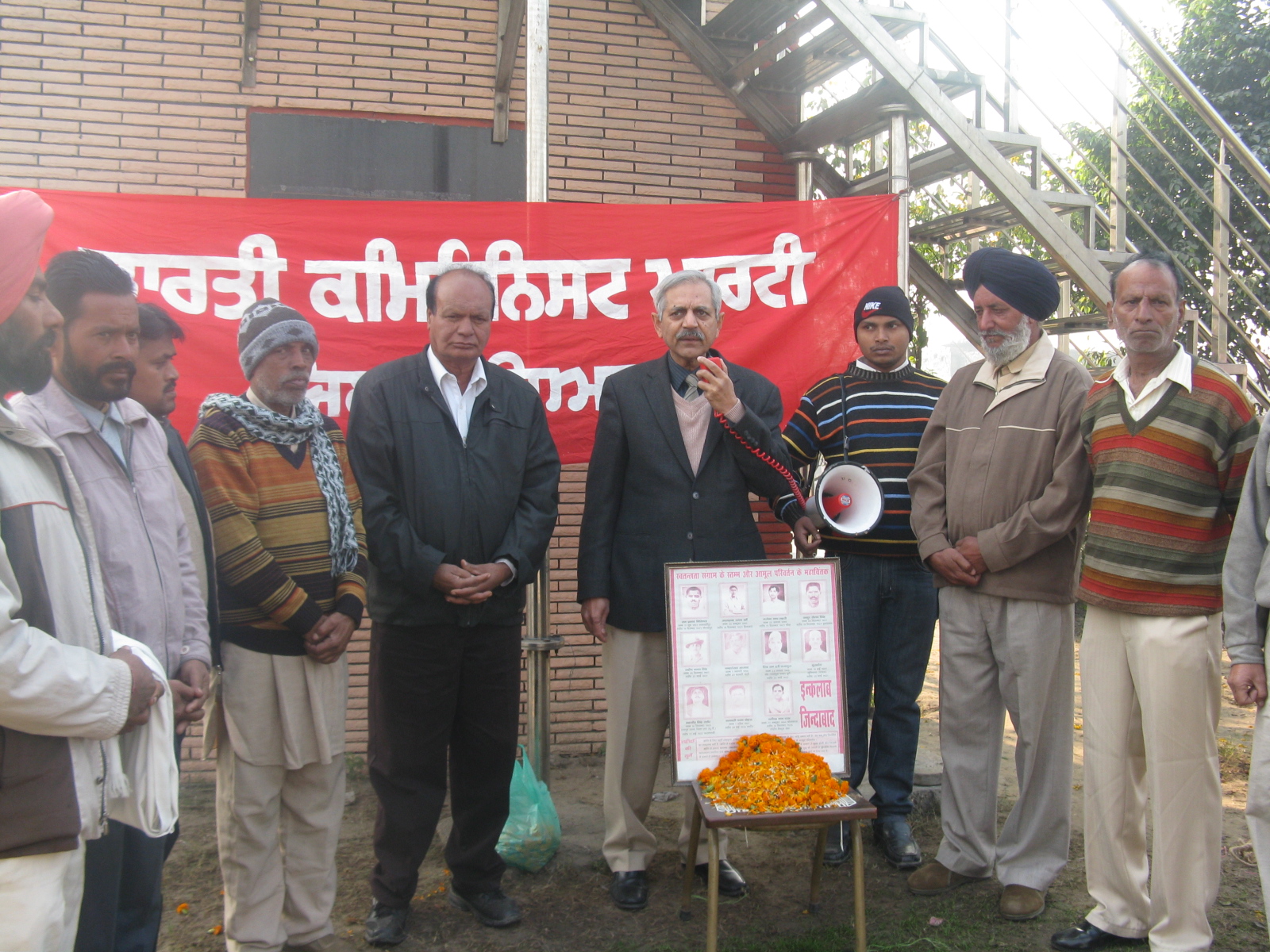
A rally was organized at the Jagraon Bridge to pay homage to the freedom fighters, Ashfaqullah Khan, Ram Prasad Bismil and Roshan Singh Thakur who were hanged by the British on 19th December and Rajinder Lahiri who was hanged on 17th December 1927 in the Kakori case. Participants garlanded the Photographs of the martyrs and then held a rally. Various speakers, while reminding the struggle waged by the great people, who did not refrain from laying down their lives for the cause of the country, said that they had dreamt of free secular, democratic India where all people enjoyed equity, justice and human rights without any linguistic, regional or gender bias and have access to necessities of life including health and education. But unfortunately this has not happened in the last 64 yrs of independence. Whereas we have grown in terms of technology and wealth, the gains of this development have gone to a few. India has gone further down to 132nd position in the Human Development Index as per the report published by the United Nations Development Programme. Economic policies have to be reviewed and changed to pro people if dreams of the martyrs have to be fulfilled.
As regards situation in Punjab the Akali –BJP combine and Congress are looting the state in turn. The state is in as serious debt crisis. This has to be stopped. Sanjha Morcha is a new light and we appeal to the people to elect the candidates of the morcha.
Those who addressed the rally include Com Kartar singh Bowani-Secretary CPI district Ludhiana, Dr Arun Mitra-Assistant Secretary CPI Ludhiana, Com Ramadhar Singh, Com Anod Kumar, Com Ramchand, Com Kameshwar, Com Buta Singh.
Sunday, December 18, 2011
We stand by the journalist community-Chhina
Chhina condemns attack,demand police action
Gajinder Singh King,
Amritsar18 December, 2011:
 Khalsa College Governing Council, Honorary Secretary, S. Rajinder Mohan Singh Chhina today strongly condemned the life threatening attack on Dainik Jagran reporter Mohinder Pal Singh. He said the act of violence in which Mohinder Pal was shot at an injured badly while he was returning home from his office duty was highly condemnable. He demanded immediate police action against those goonda elements who were behind the assault. He said the Khalsa College educational institutions respect the journalist and the right to speech and they stand by the journalist community of Amritsar who are fighting the right cause to protect the journalist. Khalsa College Governing Council, President, Satyajit Singh Majithia, Vice-President, S. Charanjit Singh Chadha, Joint Secretary (Finance), S. Gunbir Singh, Joint Secretary (Legal and Property), S. Ajmer Singh etc. also condemned the attack on the journalist.
---------------
Gajinder Singh King,
Amritsar18 December, 2011:

---------------
Saturday, December 17, 2011
Dempsey: Exit From Iraq is Not Exit From Region
The United States will offer Iraq support

American Forces Press Service
KUWAIT CITY, KUWAIT, Dec. 14, 2011 - As the last 5,700 U.S. troops leave Iraq to govern itself as a sovereign nation, the best way for the United States to support that country's success is to stay broadly engaged in the region, the chairman of the Joint Chiefs of Staff said today.
As part of his first USO holiday tour as chairman, Army Gen. Martin E. Dempsey landed at dawn at Kuwait International Airport, traveling with his senior enlisted advisor, Marine Corps Sgt. Maj. Bryan B. Battaglia, their wives, and celebrities arriving to entertain the troops.
"The exit from Iraq is not an exit from the region," Dempsey told reporters just before the USO show at Camp Buehring, one of three remaining staging posts for troops and their equipment in northwestern Kuwait.
"The best way to ensure Iraq has the kind of future we all want for it is to stay engaged broadly," the chairman said, adding that the Strategic Framework Agreement, signed by the United States and Iraq in 2008 to establish long-term bonds of cooperation and friendship, directed that the relationship be built through mutual interests in security as well as trade, education and culture, law enforcement, environment and energy.
Dempsey's thoughts about Iraq and its future arise from years of experience there.
In 1991 he deployed with the 3rd Armored Division in support of Operation Desert Storm, a war waged against Iraq by a U.N.-authorized, U.S.-led coalition force representing 34 nations in response to Iraq's invasion of Kuwait.
In June 2003, Dempsey took command of the 1st Armored Division in Baghdad and served there for 14 months. In 2005 he returned to Iraq for two years to train and equip the Iraqi security forces as commanding general of the Multinational Security Transition Command�Iraq.
"Based on the [Iraqi] security forces' ... ability to manage their internal security threats, I think they're on a very stable platform," he said.
"That needs to continue to develop," the chairman added, noting that they have work to do on building some of the architectures that define stability.
"They have and will continue to work on air sovereignty, intelligence architectures, logistics architectures and the training and education component," Dempsey said.
The United States will offer Iraq support through an Office of Security Cooperation, established to help Iraqis acquire and then learn how to use military equipment they buy from the United States.
In Iraq that office will include 157 people assigned to the U.S. embassy and under the authority of the ambassador, and some who might come in on individual contracts for two or three months at a time to help the Iraqis train on U.S. equipment.
Having spent three years in Iraq working to help the leadership establish their own stability and build their own capabilities, Dempsey said the goal always was to help Iraq become a stabilizing influence in the region.
"We always thought they had the potential to do that," he added, with their economic strength, rich cultural history, good education system, agricultural development and water resources.
Dempsey said the intense effort to move troops out of Iraq, prompted by President Barack Obama's Oct. 21 announcement of the 2011 end-of-year deadline, delayed the emotional impact of the reality.
"The truth is I only found myself thinking about that in ... the last 24 hours," he said.
In those moments, he said, "I reflected on the fact that this has been a 20-year journey for me" and others who were part of the conflict with Iraq that began in 1990.
"If you were in the service, notably in the Army, and notably the heavy force of the Army," the chairman said, "Iraq was the defining element of the last 20 years of our careers."
Dempsey said he's proud of what U.S. military forces and others did in 1991 in Iraq and what U.S. forces have done over the past eight years.
"I think we've given Iraq an enormous opportunity," he said.
"We've built relationships with the Iraqi military that will persist well into the future," Dempsey said, "and on that basis they've had the chance to become the responsible stable nation state that they say they want to become.""I think we've given Iraq an enormous opportunity," he said.
Army Gen. Martin E. Dempsey
Related Articles:
Obama Praises U.S. Troops' Efforts as Iraq Winds Down
Obama Praises U.S. Troops' Efforts as Iraq Winds Down
Panetta Defends Intelligence Operations
"These are operations I will not discuss publicly"
 Biographies:
Leon E. Panetta
By Donna Miles
American Forces Press Service
American Forces Press Service
KABUL, Afghanistan, Dec. 14, 2011 - Declining to discuss details about a U.S. RQ-170 drone aircraft that went missing in Iran, Defense Secretary Leon E. Panetta defended the use of intelligence, surveillance and reconnaissance aircraft to protect the United States.
During a joint news conference here today with Afghan President Hamid Karzai, Panetta called the drone program part of an effort "to not only protect Afghanistan, but to protect the United States."
"These are operations I will not discuss publicly," the secretary said, "other than to say that, part and parcel of our effort to defend this country and to defend our country involves important intelligence operations which we will continue to pursue."
Speaking with reporters earlier this week en route to Djibouti, the secretary also called it "appropriate" that President Barack Obama has asked Iran to return the drone, but admitted, "I don't expect that will happen."
Panetta said it's difficult to know how much engineering know-how the Iranians will be able to obtain from parts of the downed drone in its possession.
"I don't know the condition of those parts. I don't know exactly what state they are in," he said. "So it will be a little difficult to tell exactly what they are going to be able to derive from what they have been able to get."
Panetta also told reporters the United States is developing a strategic relationship with the Afghan government but it has no intention of maintaining permanent bases in Afghanistan.Leon E. Panetta
Friday, December 16, 2011
Obama Praises U.S.Troops' Efforts as Iraq Winds Down
Nearly 4,500 Americans made the ultimate sacrifice

By Jim Garamone
American Forces Press Service
American Forces Press Service
WASHINGTON, Dec. 14, 2011 - When the last U.S. troops in Iraq case their colors and move to Kuwait, they can leave with their heads held high, secure in the knowledge they did what was right for America and peace in the region, President Barack Obama told service members at Fort Bragg, N.C., today.
Obama noted the end of the war in Iraq during his speech to thousands of service members -- many of whom served multiple tours in Iraq since 2003.
The most important lesson from the war in Iraq is about America's national character, Obama said.
"For all of the challenges that our nation faces, you remind us that there's nothing we Americans can't do when we stick together," he said. "For all the disagreements that we face, you remind us there's something bigger than our differences, something that makes us one nation and one people. Regardless of color, regardless of creed, regardless of what part of the country we come from, regardless of what backgrounds we come out of, you remind us we're one nation."
That fact is why the American military is the most respected institution in the country, the president said.
The young men and women at Fort Bragg represent more than 1.5 million Americans who have served in Iraq. More than 30,000 Americans have physical wounds from the conflict with tens of thousands afflicted by unseen wounds like traumatic brain injury and post-traumatic stress.
"Nearly 4,500 Americans made the ultimate sacrifice, including 202 fallen heroes from here at Fort Bragg -- 202," Obama said. "So today we pause to say a prayer for all those families who've lost their loved ones, for they are part of our broader American family."
This 9/11 generation has earned its place in history, the president said.
"Because of you, because you sacrificed so much for a people that you had never met, Iraqis have a chance to forge their own destiny," he said. "That's part of what makes us special as Americans. Unlike the old empires, we don't make these sacrifices for territory or for resources; we do it because it's right.
"There can be no fuller expression of America's support for self-determination than our leaving Iraq to its people," he added. "That says something about who we are."
And U.S. service members in Afghanistan are taking on the Taliban and breaking the back of al-Qaida, the president said.
"Because of you, we've begun a transition to ... the Afghans that will allow us to bring our troops home from there," Obama said. "And around the globe, as we draw down in Iraq, we have gone after al-Qaida so that terrorists who threaten America will have no safe haven, and Osama bin Laden will never again walk the face of this Earth."
Soon the last soldiers will leave Iraq, and the achievements of Americans who fought there will belong to history, the president said. He compared them to the men and women who fought for independence from Great Britain and who defeated fascism and communism. He also recalled the Civil War saying this generation, like the one that fought for union, has been "touched by fire."
"All of you here today have lived through the fires of war," Obama said. "You will be remembered for it. You will be honored for it, always. You have done something profound with your lives."
Today's service members enlisted during a time of war knowing that they'd be the ones who went into harm's way, Obama said.
"When times were tough, you kept fighting. When there was no end in sight, you found light in the darkness," the president said. "And years from now, your legacy will endure in the names of your fallen comrades etched on headstones at Arlington, and the quiet memorials across our country, in the whispered words of admiration as you march in parades, and in the freedom of our children and our grandchildren."
And they will remember that they were touched by fire, and can be proud they answered the call, the president said.
"You served a cause greater than yourselves, you helped forge a just and lasting peace with Iraq and among all nations," he said. "I could not be prouder of you, and America could not be prouder of you."
Subscribe to:
Posts (Atom)